
What Is a Rice Purity Test? Meaning, History & Score Guide
What is a rice purity test?
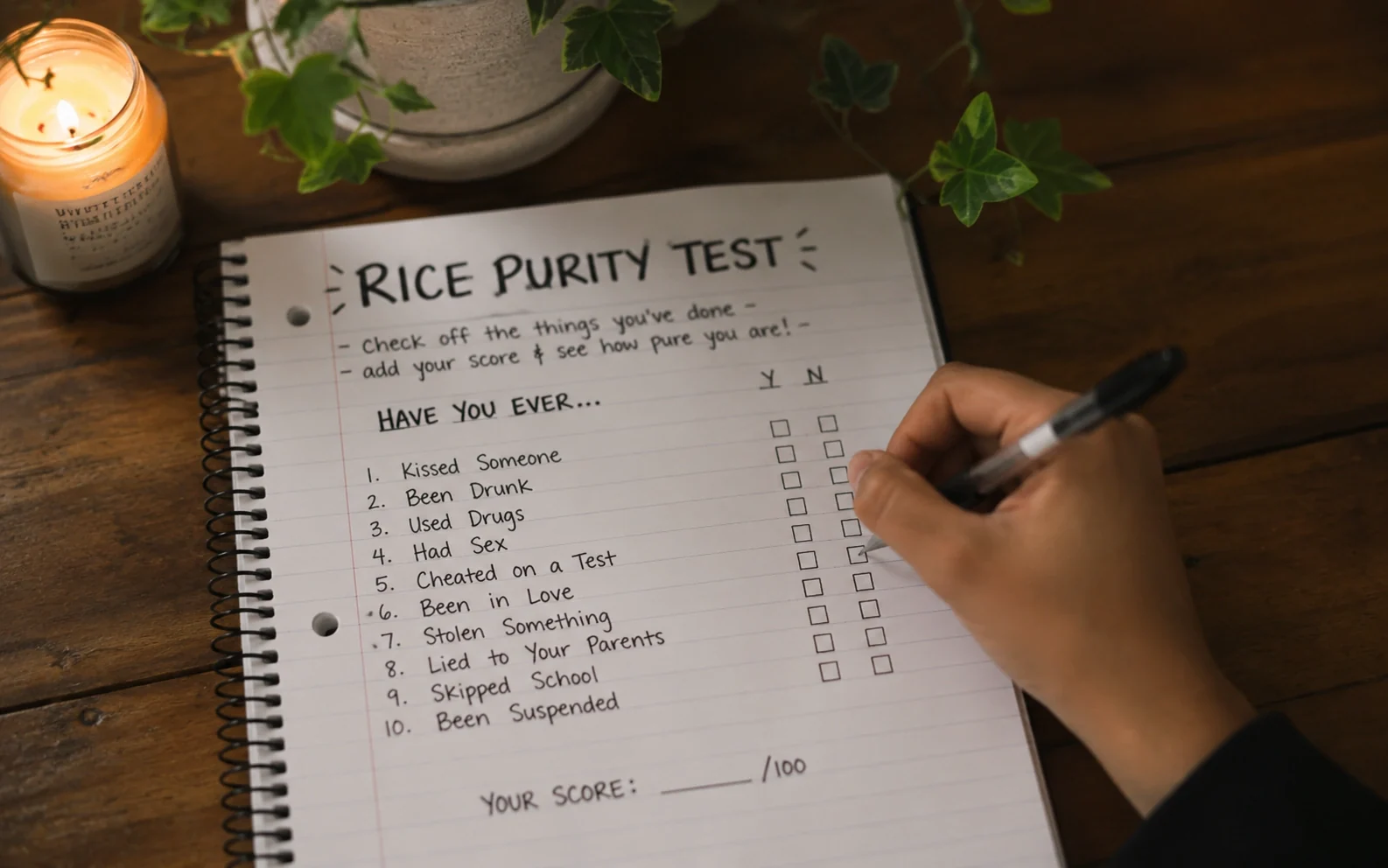
The Rice Purity Test can be understood as similar to BuzzFeed-style quizzes, but its purpose was not just mindless fun or a way to relieve boredom. It has often been used to stigmatize sexuality and other activities and to reinforce a shame culture, especially for women. Basically, a purity test is a self-administered quiz where yes/no questions are asked about sexual activities, drug use, and other activities.
Along with this, an auto-score is also displayed at the top, which updates in real time. This score is usually in percentage form, where 100% represents the most pure and 0% represents the least pure.
What is the Meaning of the Rice Purity Test
The Rice Purity Test is a self-assessment calculator that gives individuals a chance to think about their past experiences and personal choices. It estimates the participants’ supposed innocence in worldly matters, such as drug-related matters, sexual activities, and other activities that are commonly considered vices. Today, it has become a popular online quiz that serves as an engaging way for people of all ages to reflect on their life journey. It is usually based on a percentage scale, where 100% is considered the most pure and 0% is considered the least pure.
The Rice Purity Test is based on a series of carefully crafted questions. It measures the participants’ level of innocence or exposure to different life experiences. Each question is usually related to personal, intimate, or social activities, and it encourages respondents to think critically about their past interactions, decisions, and the boundaries they have set in life.
So, if you are ready to explore your past and understand yourself more deeply, take a moment to engage with our online Rice Purity Test. It is an interesting and thought-provoking way to reflect on the experiences that shape who you are today.
What is the history of the Rice Purity Test?
The Rice Thresher student newspaper published the results of an informal ten-question survey of 119 female undergraduate students at Rice University in 1924. It included questions such as “Been in a relationship?”, “kissed a non-family member on the lips?”, and “Danced without leaving room for Jesus?” The Thresher revisited and revised this test from time to time, usually on its satirical “Backpage.”
Later, the lists of questions were expanded, where students could take the test themselves and calculate their own score. This process started with a list of 150 questions in 1988. The newspaper staff had different opinions about the test, but it continued to be published in most years until 2012.
When purity tests spread to other universities during the mid-20th century, folklorists formally documented them as a form of “questionnaire parody,” reflecting changing social norms.
Why is it called the Rice Purity Test?
In our culture, the obsession with virginity and “purity” is often considered very extreme, and this is not something new, especially for women and girls. Like many social issues in the world, the construct of virginity and “purity” has also historically been connected with ideas that were used to control women’s bodies and lives. This may sound harsh, but in power structures, it is not difficult to understand that dominant groups often try to retain their power by controlling or judging another person’s personal past.
Along with this, there is also a double standard: women and girls are expected to be attractive and appealing, but if they express their agency or choices, they are negatively labeled. This discussion leads to the topic of the Rice Purity Test. If you have not heard about it before, below is an overview of the Rice Purity Test and the background of some other purity tests throughout history.
What is an Innocence Test?
The purity test has continued to evolve since the 1920s. Recently, in 2021, it became popular on TikTok under the name The Innocence Test. Like other purity tests, the Innocence Test also asks about so-called rebellious activities, but its situations are more modern and also include technology-related examples.